



Trusted by 10,000+ families nationwide

Create Your
Living Trust
in 7 Simple Steps

Protect your family from probate court, keep your estate private, and make sure your wishes are followed. No attorney required to build it, which saves you thousands in fees. And when you want one, we connect you with a licensed attorney in your state for review.

No attorney requiredSave over $20,000 in fees over the lifetime of your trust management by using our dashboard
Protect your family's privacy
Skip probate court entirely
Works in all 50 states

Trusted by attorneys and paralegals everywhere

0+

Trusts Created

0+

Families Protected

0+

Attorney Partners

0

States Covered

Family planning their estate and trust
TRUST TYPES

Eight Trust Types to Fit Your Situation

Not sure which trust you need? Our wizard asks about your goals and recommends the right type. Browse the options below.

Revocable Living Trust

The most common starting point for estate planning

You maintain full control during your lifetime and can modify or revoke it anytime. Assets transfer to beneficiaries without probate, maintaining privacy and speeding up distribution. However, it offers minimal asset protection since you retain control.

Best For

  • Homeowners who want to avoid probate
  • Parents with minor children
  • Anyone who values privacy

Irrevocable Life Insurance Trust (ILIT)

Keep life insurance proceeds out of your taxable estate

Holds life insurance policies outside your taxable estate. The death benefit passes to beneficiaries free of estate taxes, which is particularly valuable for high-net-worth families. Once established, you give up control of the policy, but the tax savings can be substantial.

Best For

  • High-net-worth families with large life insurance policies
  • Individuals with estates exceeding the federal exemption
  • Business owners using key-person insurance

Dynasty Trust (Generational Trust)

Multi-generational wealth that lasts forever

Built for multi-generational wealth transfer, these trusts can last for multiple generations (or perpetually in certain states like Nevada, South Dakota, and Delaware). Assets grow tax-free and are protected from beneficiaries' creditors, divorces, and lawsuits across generations.

Best For

  • Families building multi-generational wealth
  • High-net-worth individuals in dynasty-friendly states
  • Business families passing ownership across generations

Asset Protection Trust (Domestic or Offshore)

Shield your wealth from lawsuits and creditors

Specifically structured to shield assets from future creditors, lawsuits, and judgments. States like Nevada, Wyoming, Delaware, and South Dakota offer strong domestic options. These are irrevocable and require giving up some control, but provide robust protection when properly funded in advance of any claims.

Best For

  • Doctors, surgeons, and medical professionals
  • Business owners in high-liability industries
  • Real estate investors and developers

Charitable Remainder Trust (CRT)

Give back while receiving tax benefits and income

Allows you to donate assets, receive income during your lifetime, and ultimately benefit a charity. You get an immediate tax deduction, avoid capital gains on appreciated assets, and create a family legacy of giving while still receiving income.

Best For

  • People with highly appreciated assets (stocks, real estate)
  • Retirees seeking additional income with tax advantages
  • Philanthropists who want to support charities and family

Family Limited Partnership with Trust

Transfer business interests while maintaining control

Combines a family limited partnership or LLC with trust structures to transfer business interests or real estate at discounted values. Provides asset protection, facilitates gradual wealth transfer to children, and allows senior family members to maintain management control while reducing estate taxes.

Best For

  • Business owners wanting to transfer ownership gradually
  • Families with significant real estate holdings
  • Parents who want children to inherit at discounted values

508(c)(1)(A) Trust

Automatic tax exemption for religious organizations

A specialized trust structure under IRC Section 508(c)(1)(A) for churches, religious organizations, and their integrated auxiliaries. Automatically recognized as tax-exempt without filing Form 1023 or Form 990. Protected by the First Amendment with unique operational privacy.

Best For

  • Churches and houses of worship
  • Religious ministries and mission organizations
  • Faith-based charitable outreach programs
Explore the Full 508(c)(1)(A) Experience

501(c)(3) Charitable Organization Trust

IRS-recognized tax-exempt charitable status

A trust structured to qualify for tax-exempt status under IRC Section 501(c)(3). Organized and operated exclusively for charitable, religious, educational, scientific, or literary purposes. Donors receive tax deductions for contributions, and the organization is eligible for grants and public funding.

Best For

  • Charitable foundations and nonprofit organizations
  • Educational institutions and scholarship programs
  • Scientific research organizations

Have a Specific Situation?

Need a specialized trust structure? Our trust agents can help you find the right solution for your unique situation. Call us directly for a free consultation.

(888) 534-4145

Mon-Fri 9am-6pm EST

Ready to protect your family?

Start the 7-step wizard and create your trust in about 45 minutes.

THE PROCESS

How the 7-Step Wizard Works

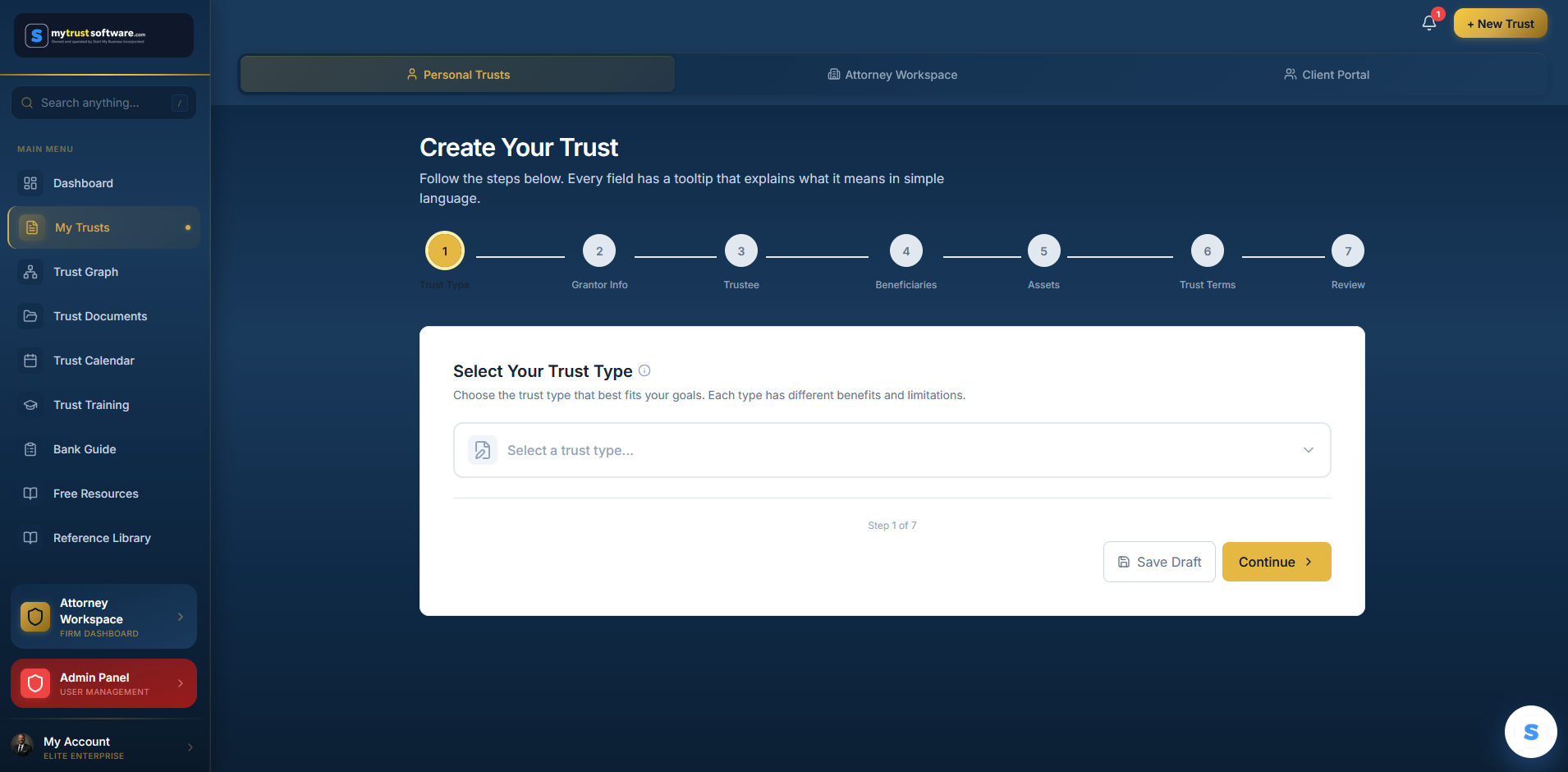
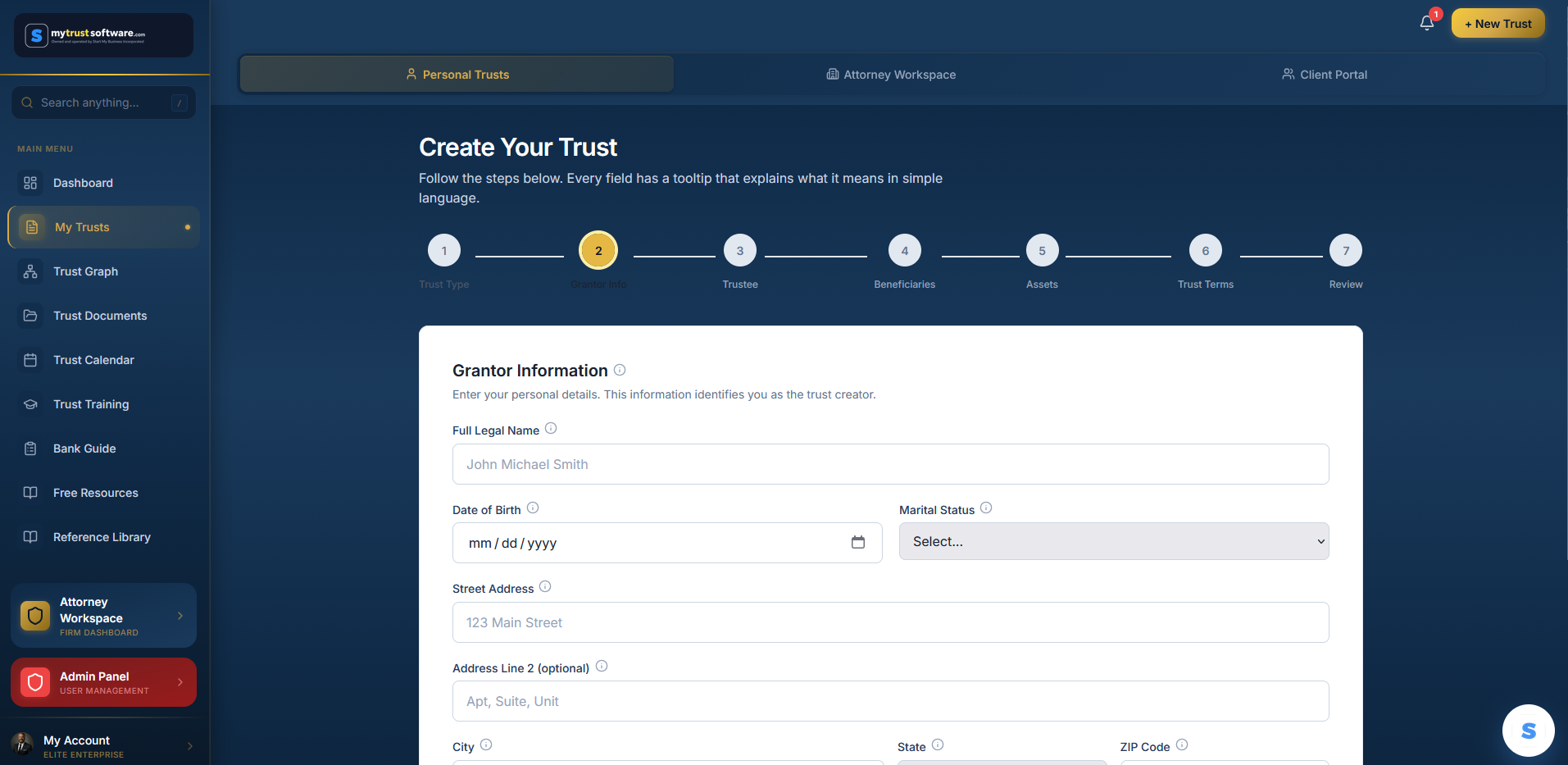
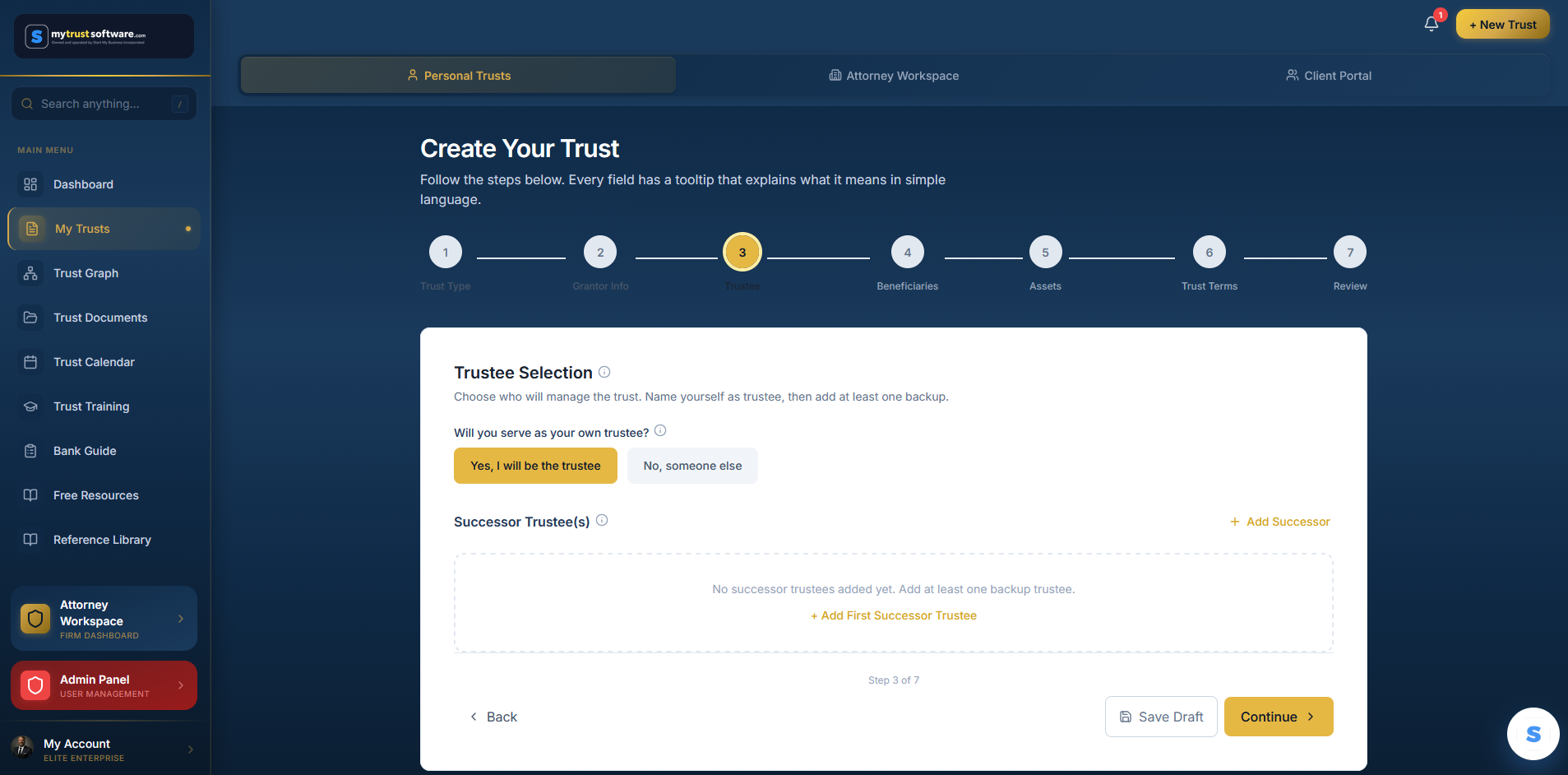
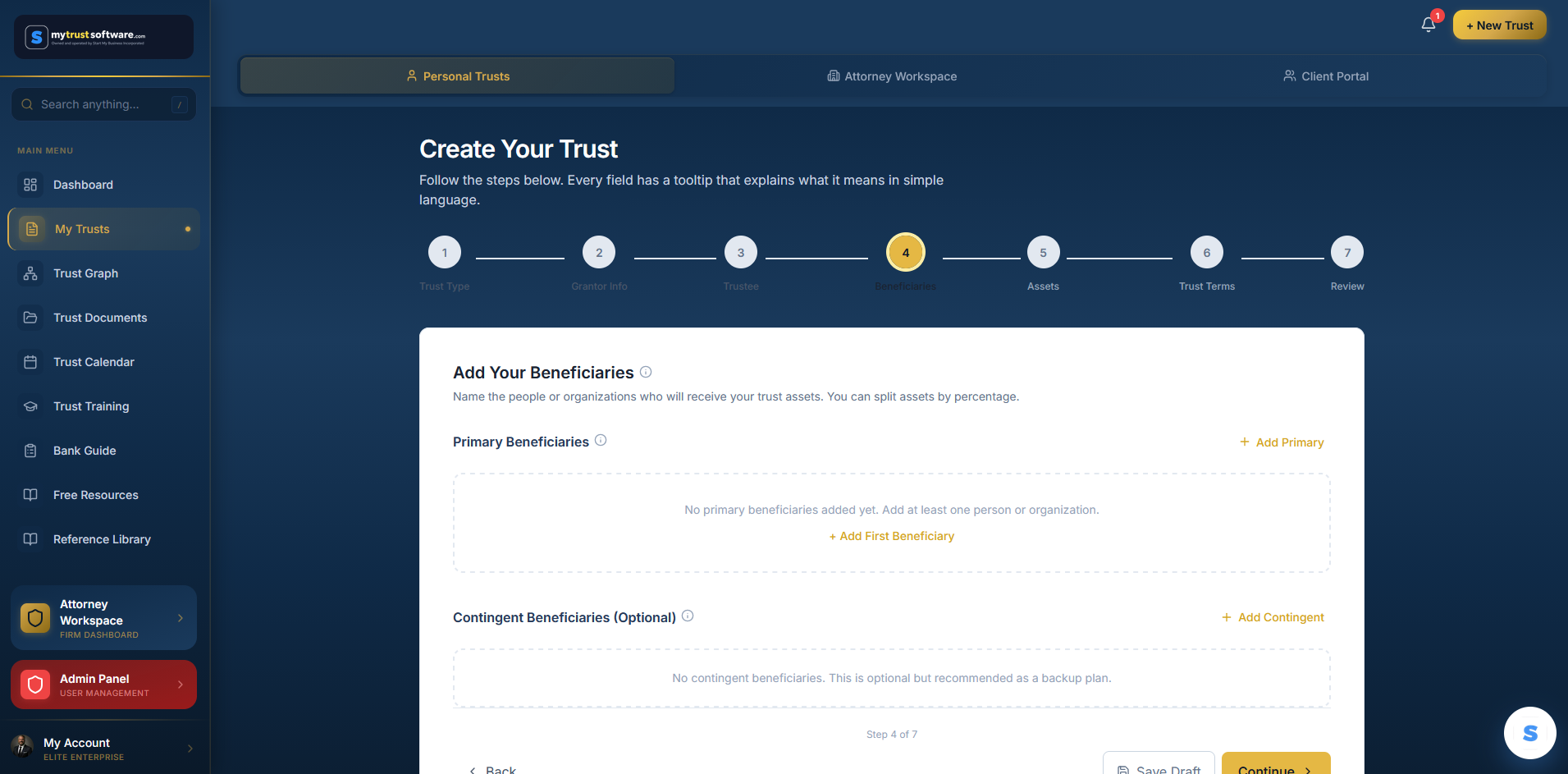
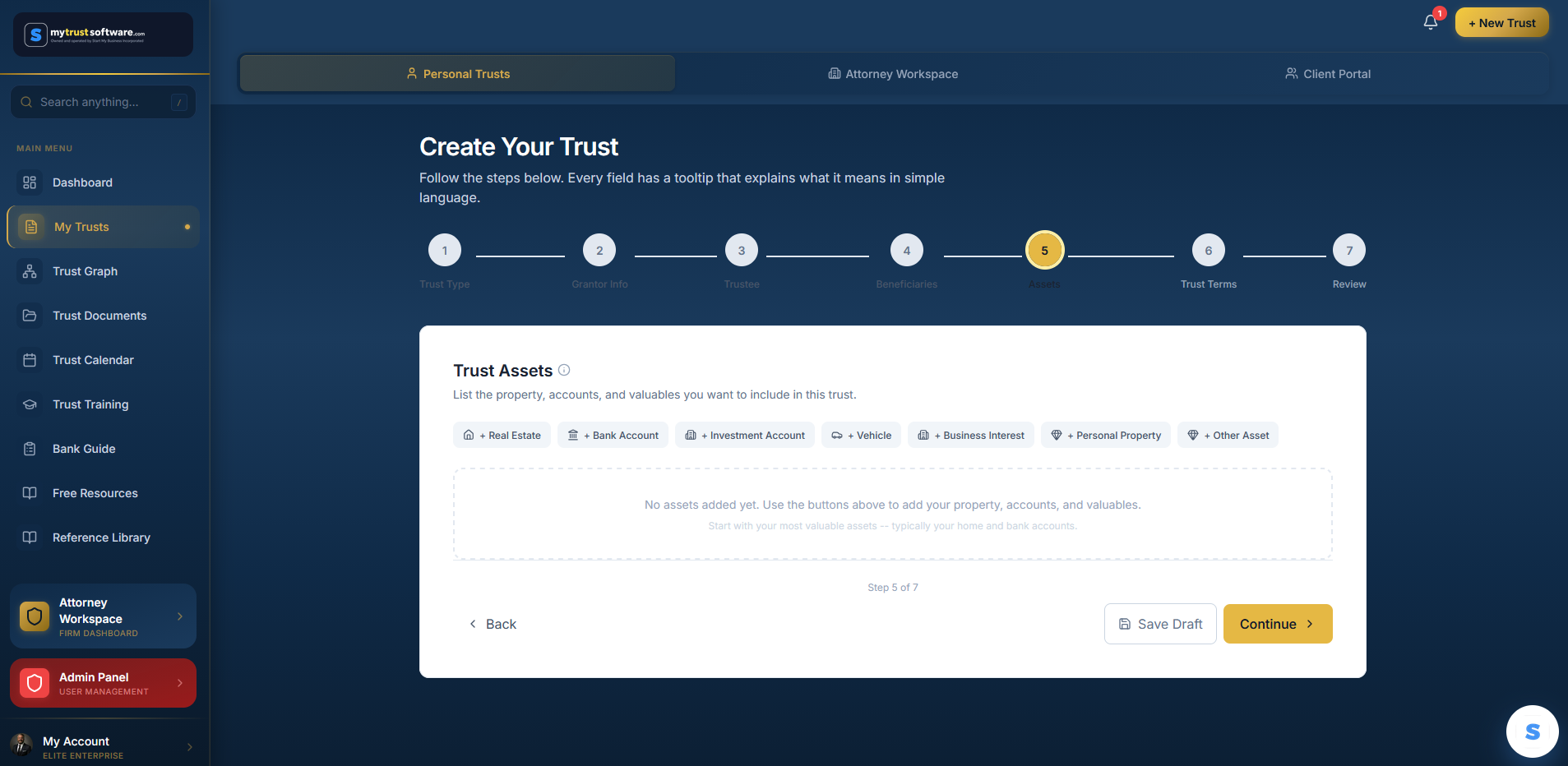
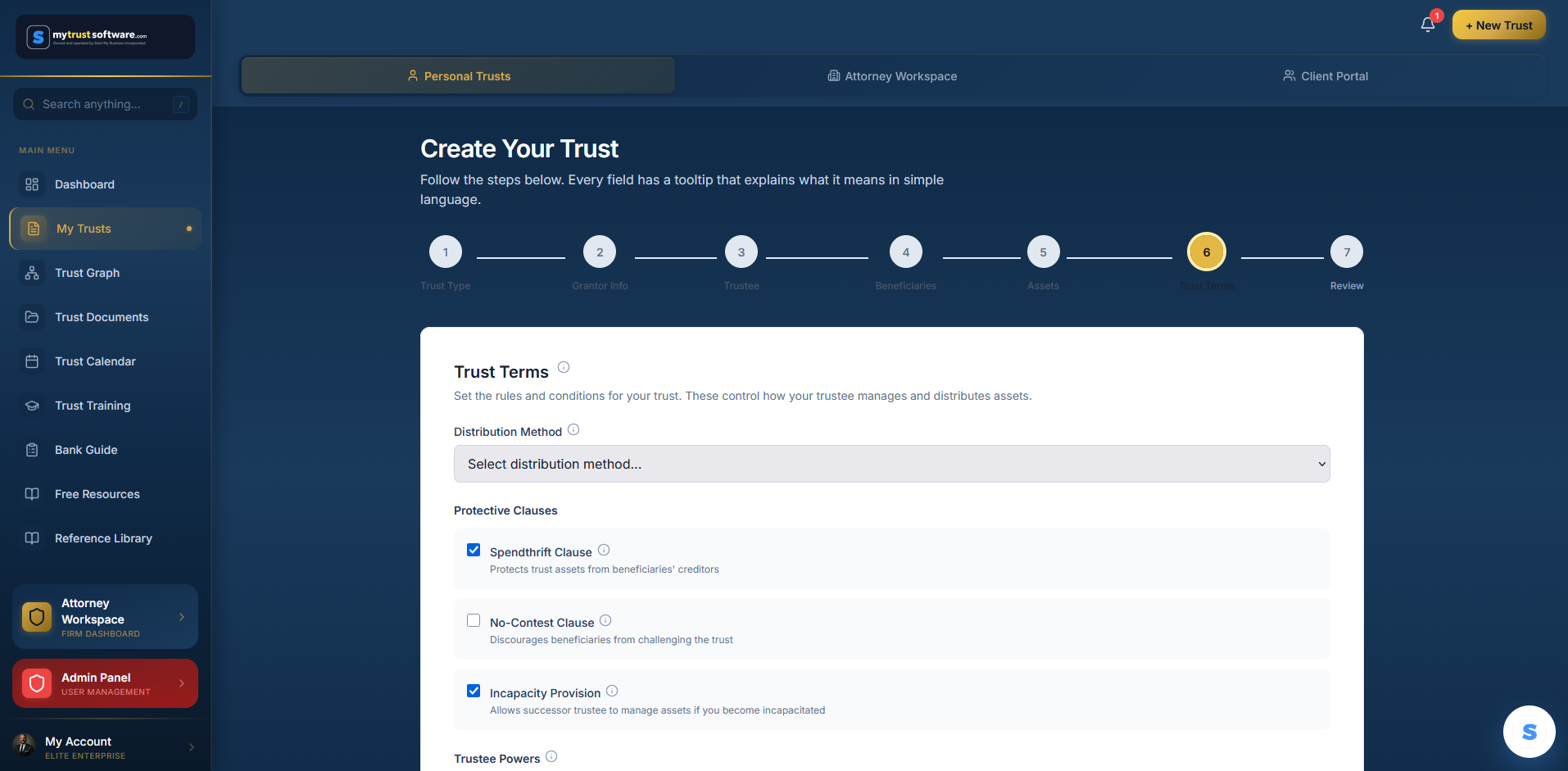
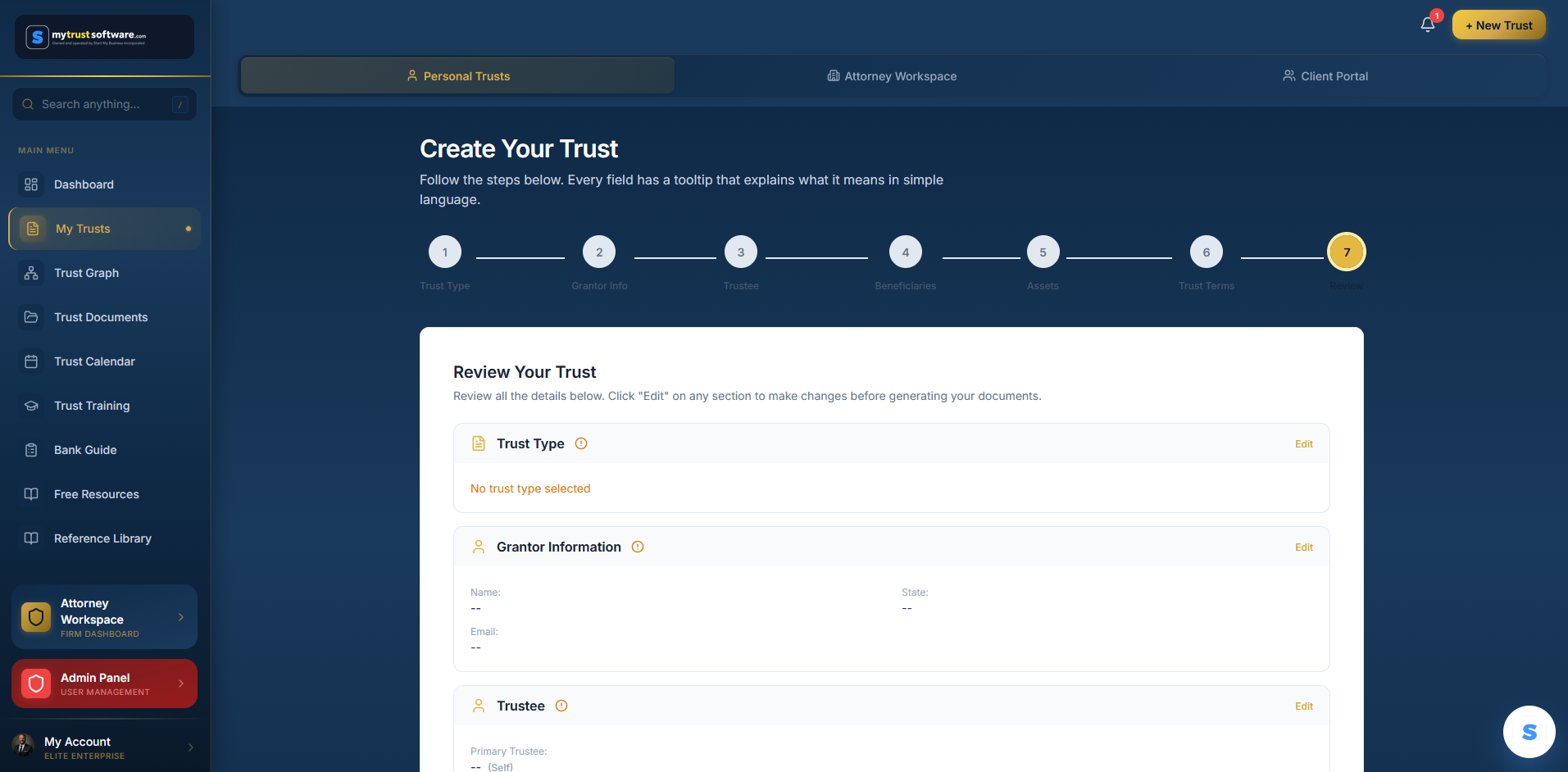
Our guided process makes trust creation straightforward. Every field has a tooltip that explains what it means in plain English. Your progress saves automatically.

Trust creation wizard dashboard on a laptop

Choose Your Trust Type

Answer a few questions about your goals, and our wizard recommends the right trust type for your situation. Or pick one yourself from six options.

  • Revocable Living Trust -- the most popular choice for probate avoidance
  • Irrevocable Trust -- for asset protection and tax planning
  • Special Needs Trust -- protect benefits for a disabled loved one
  • Charitable Trust -- support causes you care about with tax advantages
  • Asset Protection Trust -- shield wealth from lawsuits and creditors
  • Family Trust -- control when and how your heirs receive their inheritance

Enter Grantor Information

Tell us about yourself (the trust creator). Your legal name, address, and state of residence. We use this to apply the right state laws to your trust.

  • Full legal name as it appears on your ID
  • Current home address
  • State of residence (determines governing law)
  • Marital status (affects trust structure for couples)
  • Every field has an info icon explaining what it means and why we need it

Select Your Trustee

Name the person (or company) who will manage the trust. During your lifetime, that is usually you. Then pick a successor trustee for when you can no longer serve.

  • Primary trustee (typically yourself for revocable trusts)
  • Successor trustee -- the person who takes over
  • Optional: second successor trustee as a backup
  • Option to name a corporate trustee (bank or trust company)
  • Plain-English explanation of trustee duties and responsibilities

Add Your Beneficiaries

Name the people or organizations who will receive assets from your trust. Set their shares, add conditions, and decide how distributions work.

  • Add unlimited beneficiaries by name and relationship
  • Assign percentage shares or specific assets to each person
  • Set age-based distribution schedules (e.g., 1/3 at 25, 1/3 at 30, rest at 35)
  • Add conditions (education requirements, employment, etc.)
  • Name contingent beneficiaries in case a primary beneficiary cannot receive their share

List Your Assets

Add the property and accounts you want the trust to hold. Real estate, bank accounts, investments, vehicles, and personal property -- everything gets cataloged.

  • Real estate (addresses, property type, estimated value)
  • Bank and savings accounts
  • Investment and brokerage accounts
  • Vehicles (make, model, year)
  • Valuable personal property (jewelry, art, collectibles)
  • Business interests and ownership stakes
  • Life insurance policies (where applicable)

Set Trust Terms

Define the rules your trustee must follow. Distribution triggers, trustee powers, spendthrift clauses, and any special instructions you want to include.

  • Trustee powers (investment, property management, distributions)
  • Distribution rules and triggers
  • Spendthrift protection for beneficiaries
  • No-contest clause to prevent legal challenges
  • Special instructions (pet care, funeral wishes, etc.)
  • Governing state law selection

Review and Generate

Review every detail of your trust in a clear summary. Make any final changes, then generate your professional trust document as a downloadable PDF.

  • Full summary of all trust details on one page
  • Edit any section before generating
  • Generate trust agreement PDF
  • Generate certificate of trust
  • Generate Schedule A (asset list)
  • Download all documents instantly
  • Print-ready formatting with professional legal language
WATCH IT IN ACTION

See the Trust Creation Wizard in Action

Watch a 3-minute walkthrough of our 7-step wizard. See how easy it is to create a trust from start to finish -- no legal experience needed.

Understanding Trust Types

Creating Your First Trust

Side-by-Side Comparison

Trust vs. Will: Why a Trust Wins

A will and a trust are both estate planning tools, but they work very differently. Here is a side-by-side comparison of what each one offers your family.

Probate required

Living Trust

No probate

Will Only

Always goes through probate

Privacy

Living Trust

Completely private

Will Only

Becomes public record

Time to distribute assets

Living Trust

2 to 8 weeks

Will Only

6 months to 2 years

Cost after death

Living Trust

Minimal (no court fees)

Will Only

3-7% of estate value

Incapacity protection

Living Trust

Built in -- trustee takes over

Will Only

None -- requires conservatorship

Multi-state property

Living Trust

One trust covers all states

Will Only

Separate probate per state

Effective immediately

Living Trust

Works right away

Will Only

Only after death + court approval

Difficulty to contest

Living Trust

Harder to challenge

Will Only

Easier to contest in court

Control over distributions

Living Trust

Full control (age, conditions)

Will Only

Limited (outright or basic conditions)

Ongoing management

Living Trust

Trustee manages continuously

Will Only

Executor only during probate

Bottom line: You need both a trust and a will. But the trust handles 95% of the work and protects your family from probate. The will serves as a backup for anything the trust does not cover.

Trust Education

What Exactly Is a Trust, and Why Does Your Family Need One?

A trust is not just for the wealthy. It is a basic tool that protects every family.

A trust is just a document that names three roles: who owns the assets, who manages them, and who receives them. Here is how those parties relate.

Grantor

Creates the trust and places assets in it

Grantor

Trustee

Manages assets per the instructions

Trustee

Successor Trustee

Steps in at incapacity or death

Beneficiary

Beneficiaries

Receive assets on your terms

Party 4
For a revocable living trust you are usually grantor and trustee at the same time, so daily life does not change.

Key Takeaways

Trusts skip probate, saving your family 3-7% of your estate value

Your estate stays completely private (probate is public record)

A trust protects you during your lifetime if you become incapacitated

Parents can control when and how children receive their inheritance

You do not need to be wealthy to benefit from a trust

Most people hear the word "trust" and think of wealthy families with teams of lawyers. That picture is outdated and wrong. A trust is simply a legal document that says: here are my assets, here is who manages them, and here is who gets them when I am gone.


Listen to this section
Trust Education

The Real Cost of Not Having a Trust: What Probate Does to Your Family

Probate is the default. A trust is the opt-out.

On a $550,000 estate, probate quietly drains roughly $22,000 and 14 months from your family. A funded trust delivers the same assets in weeks for nothing.

Probate vs. Trust on a $550,000 estate

months to distribute

  1. Probate (court process)14 months
  2. Trust (successor trustee)4-8 weeks
PreferredAvoid

Key Takeaways

Probate takes 6 months to 2 years on average

Costs run 3-7% of the total estate value

Every asset and distribution becomes public record

Multiple states mean multiple probate proceedings

A trust eliminates 100% of the probate process

Let's talk about what actually happens when someone dies without a trust.

Listen to this section
Trust Education

Revocable Living Trusts: The Foundation of a Modern Estate Plan

How the most popular trust type works, who needs one, and what to watch out for.

A revocable living trust is the foundation of about 80% of estate plans. Here is what it actually does for you, separated from the myths.

What a revocable living trust does (and does not) do

  • Avoids probate, saving time, money, and privacy
  • Provides immediate incapacity protection
  • Lets you control distributions to beneficiaries
  • Works across state lines with one document
  • Keeps your estate completely private
  • You keep full control as grantor and trustee
  • Myth: you lose control of your assets
  • Myth: it lowers your income taxes
  • Myth: it protects assets from creditors
  • Myth: you need a lawyer to create one
6 of 10 included

Key Takeaways

You maintain full control as both grantor and trustee

Must be funded (transfer assets in) to actually work

Does not change your income tax situation

Does not provide creditor protection

Becomes irrevocable automatically when you die

A revocable living trust is the starting point for about 80% of estate plans. It is called "revocable" because you can change or cancel it anytime. It is called "living" because you create it while you are alive (as opposed to a testamentary trust, which is created through a will and only activates after death).

Listen to this section
Trust Education

Irrevocable Trusts: When You Need Real Asset Protection

Giving up control to gain protection -- how irrevocable trusts work and who benefits most.

An irrevocable trust trades control for protection. You give up ownership, and in return you get estate tax savings, creditor shielding, and Medicaid planning.

Weighing Your Options

Every trust structure involves tradeoffs. Understanding them is the first step to the right choice.

A

What you give up

  • Control and ownership of the assets
  • The ability to change your mind or undo it
  • Income taxed at compressed rates (37% at ~$14,450)
  • Must file its own return (Form 1041)
B

What you gain

  • Assets removed from your taxable estate
  • Strong creditor and lawsuit protection
  • Medicaid eligibility after the 5-year look-back
  • ILIT keeps a life insurance payout out of the estate

The right trust depends on your goals. Neither side is wrong — only what fits your situation.

Key Takeaways

Assets are permanently removed from your estate

Strong creditor and lawsuit protection

Can help with Medicaid eligibility planning

Trust income is taxed at compressed rates

Cannot be easily changed or undone

An irrevocable trust is the opposite of a revocable trust in one fundamental way: once you create it and transfer assets in, you cannot easily take them back or change the terms. You give up ownership. The trust becomes a separate legal entity with its own tax ID number and its own tax return.

Listen to this section
Trust Education

What Every Trustee Needs to Know: Duties, Powers, and Liabilities

Being a trustee is a serious job. Here is what it involves.

Being a trustee is a legally binding job. These six fiduciary duties define the role, and violating any of them can trigger personal liability.

The six core fiduciary duties of a trustee

  • Duty of Loyalty: act in beneficiaries' interest, never your own
  • Duty of Prudent Administration: manage assets carefully and diversify
  • Duty to Keep Records: track every transaction accurately
  • Duty to Inform Beneficiaries: keep them reasonably updated
  • Duty Not to Delegate Improperly: hire help but keep core decisions
  • Duty of Impartiality: treat multiple beneficiaries fairly
  • Self-dealing or favoritism gets you removed
  • Negligent investing makes you personally liable
6 of 8 included

Key Takeaways

Trustees owe fiduciary duties: loyalty, prudence, record-keeping, impartiality

Violation of duties can result in personal liability

You can hire professionals but cannot fully delegate core responsibilities

Accurate record-keeping is legally required

You can decline or resign from the trustee role

When someone names you as their trustee, they are placing their financial life in your hands. A trustee's responsibilities are legally binding, and courts take violations seriously. Whether you are serving as your own trustee for a revocable trust or have been named as someone else's trustee, you need to understand what the role requires.

Listen to this section
Trust Education

Estate Planning Basics: Building a Complete Plan Around Your Trust

A trust is the centerpiece, but you need supporting documents too.

A trust is the centerpiece, but a complete plan layers supporting documents so every scenario is covered without a courtroom.

  1. Living Trust

    Core document: holds assets, names beneficiaries, handles incapacity and death

  2. Pour-Over Will

    Catches anything not transferred into the trust

  3. Durable Power of Attorney

    Financial decisions for assets outside the trust

  4. Healthcare Directive

    States your wishes for medical treatment

  5. Healthcare Power of Attorney

    Names someone to make medical decisions

  6. HIPAA Authorization

    Lets your people access medical records

  7. Nomination of Guardian

    Names who raises your minor children

Key Takeaways

A complete plan includes trust, will, power of attorney, and healthcare documents

The pour-over will catches assets missed by the trust

Power of attorney covers assets outside the trust

Healthcare directive and healthcare power of attorney handle medical decisions

Review your plan every 3-5 years or after major life events

Creating a trust is the single most impactful step in estate planning, but it is not the only step. A complete estate plan includes several documents that work together to cover every scenario.

Listen to this section
Trust Education

How to Fund Your Trust: The Step Most People Skip (And Why It Matters)

An unfunded trust is just a stack of paper. Here is how to put assets inside it.

An unfunded trust provides zero protection. Funding means retitling each asset into the trust's name, one category at a time.

  1. Real estate

    Record a new deed at the county recorder ($10-$150); Garn-St. Germain protects your mortgage

  2. Bank & savings accounts

    Retitle with your certificate of trust

  3. Brokerage accounts

    Use the firm's retitle forms (Fidelity, Schwab, Vanguard)

  4. Life insurance

    Name the trust as beneficiary, do not transfer the policy

  5. Retirement accounts

    Name people primary, trust as contingent; never transfer directly

  6. Personal property & business

    List in Schedule A; assign LLC or partnership interests

Key Takeaways

An unfunded trust provides zero protection

Real estate transfers require a new deed filed with the county

The Garn-St. Germain Act protects your mortgage during trust transfers

Never transfer retirement accounts directly into a revocable trust

Our platform provides a customized funding checklist for your assets

Creating a trust document is step one. Transferring your assets into the trust -- called "funding" -- is step two. Many people complete step one and never do step two. An unfunded trust provides zero protection, zero probate avoidance, and zero incapacity planning.

Listen to this section
Trust Education

Trust Laws by State: What You Need to Know Where You Live

Every state has its own trust rules. Here is an overview of the key differences.

Trust law is set state by state. Where you live decides your estate tax threshold, whether you can build a dynasty trust, and how creditor protection works.

Jurisdiction Matters

State-Specific Legal Distinctions

Community property states

0
AZCAIDLANVNMTXWAWI
Most property earned in marriage is owned equally; a joint trust is the natural fit

Own estate tax (lower threshold)

0
ORMACTILMDMNNYWA
Oregon and Massachusetts start at just $1 million

Domestic asset protection (DAPT)

0
AKCOCTDEHIINMIMSMONVNHOHOKRISDTNUTVAWVWY
Self-settled asset protection trusts allowed; you need a trustee located there

No trust income tax

0
AKFLNVNHSDTNTXWAWY
Popular situs choices for high-income irrevocable trusts

Dynasty trust friendly

0
AKDEIDKYNVNHOHSDWIWY
Rule against perpetuities abolished or extended (Delaware unlimited, Alaska 1,000 years)

Key Takeaways

Over 30 states follow the Uniform Trust Code

Community property states affect how married couples structure trusts

12+ states have their own estate taxes with lower thresholds

20+ states allow domestic asset protection trusts

Several states allow trusts to last indefinitely (dynasty trusts)

Trust law is governed primarily by state law, not federal law. While the basics are similar across states, the details can differ significantly. Knowing your state's rules helps you make better decisions about your trust.

Listen to this section
Trust Education

10 Trust Mistakes That Could Cost Your Family Thousands

Avoid these common errors that undo the protection a trust is supposed to provide.

Creating a trust is the easy part. These ten mistakes quietly undo the protection a trust is supposed to provide, starting with the one that wrecks about 40% of trusts.

01

Not funding the trust

~40% never fully funded
02

Forgetting to update after major life events

03

Choosing the wrong trustee

04

Naming minor children as direct beneficiaries

Court controls funds until age 18
05

Ignoring tax implications

06

Using a generic template without customization

07

Not including a no-contest clause

08

Failing to plan for digital assets

09

Not having a pour-over will

10

Setting it and forgetting it

Review every 3-5 years

Key Takeaways

Unfunded trusts are the #1 mistake in trust planning

Always update your trust after major life events

Choose trustees based on reliability and financial ability, not just relationship

Never name minor children as direct beneficiaries of financial accounts

Review your trust every 3-5 years

Creating a trust is a great step. But trust planning has pitfalls that trip up even well-intentioned people. Here are the most common mistakes and how to avoid them.

Listen to this section
Trust Education

Trusts and Digital Assets: Protecting Your Online Life

Your digital life is valuable. Your estate plan should include it.

Most estate plans written before 2015 say nothing about your online life. Crypto, accounts, and cloud media all need explicit trust provisions and an access plan.

Your digital estate checklist

  • Include digital asset provisions in your trust
  • Keep an encrypted inventory of accounts and passwords
  • Set up Google Inactive Account Manager
  • Set up Apple Digital Legacy
  • Name a Facebook Legacy Contact
  • Document crypto private keys and seed phrases
  • Without keys, cryptocurrency is gone forever
  • Terms of service can override default fiduciary access
6 of 8 included

Key Takeaways

Digital assets include crypto, online accounts, social media, and digital media

Most estate plans written before 2015 do not address digital assets

RUFADAA gives trustees legal authority to access digital accounts

Cryptocurrency requires private keys -- without them, it is gone forever

Set up legacy features on Google, Apple, and Facebook now

Most estate plans written before 2015 say nothing about digital assets. That is a problem, because for many people, digital assets represent significant financial and sentimental value.

Listen to this section
Trust Education

Trust vs. Will: A Side-by-Side Comparison

Both are important, but they do very different things.

You probably need both, but they do very different jobs. A trust handles the heavy lifting; a will is the backup that also names a guardian.

When it takes effect

WillOnly after death
TrustImmediately, during life and after

Avoids probate

Will
Trust

Stays private

Will
Trust

Incapacity protection

Will
Trust

Covers multi-state property

WillSeparate probate per state
TrustOne trust, all states

Speed of distribution

Will6 months to 2 years
Trust2 to 8 weeks

Cost to execute

Will3-7% of estate
TrustVirtually free

Names a guardian for kids

Will
Trust

Key Takeaways

A trust works during your life and after death; a will only works after death

Trusts avoid probate; wills always go through probate

Trusts are private; wills become public record

You need both: a trust for most assets and a will for guardianship and as a backup

Trust distribution takes weeks; probate takes months to years

The trust vs. will debate is one of the most common questions in estate planning. The short answer: you probably need both, but the trust does most of the heavy lifting.

Listen to this section
Trust Education

Special Needs Trusts: Protecting a Loved One Without Losing Their Benefits

How to provide for someone with a disability while keeping their government benefits intact.

A direct inheritance can wipe out SSI and Medicaid, which cut off at $2,000 in countable assets. A special needs trust supplements benefits instead of replacing them.

What a special needs trust can and cannot pay for

  • Supplemental medical care beyond Medicaid
  • Personal care attendants and companions
  • Education and training programs
  • Recreation, travel, and entertainment
  • Electronics, furniture, and a vehicle
  • Hobbies, pet care, and quality-of-life expenses
  • Food and shelter (counts as in-kind support)
  • Cash paid directly to the beneficiary
6 of 8 included

Key Takeaways

Inheriting even a small amount can disqualify someone from SSI and Medicaid

A special needs trust supplements government benefits without replacing them

Third-party trusts have no Medicaid payback requirement; first-party trusts do

Trust distributions should go to vendors, not directly to the beneficiary

A letter of intent helps future trustees understand the beneficiary's needs

If you have a family member with a disability, estate planning gets more complicated. A well-meaning inheritance can actually hurt the person you are trying to help. Here is why, and what to do about it.

Listen to this section
Trust Education

Charitable Trusts: Give to Causes You Care About While Reducing Your Tax Bill

Two types of charitable trusts offer different tax benefits depending on your goals.

Charitable trusts let you support a cause and cut your tax bill. The two types run in opposite directions: one pays you first, the other pays charity first.

Who gets income first

Charitable Remainder Trust (CRT)You (or your chosen person)
Charitable Lead Trust (CLT)The charity

Who gets the remainder

Charitable Remainder Trust (CRT)Charity
Charitable Lead Trust (CLT)Your heirs

Avoids capital gains on appreciated assets

Charitable Remainder Trust (CRT)
Charitable Lead Trust (CLT)

Payout rules

Charitable Remainder Trust (CRT)5%-50%, leave 10%+ for charity
Charitable Lead Trust (CLT)Fixed % or amount to charity for a term

Best for

Charitable Remainder Trust (CRT)Income for life plus a future gift
Charitable Lead Trust (CLT)Passing wealth to heirs at reduced tax

Annual tax filing

Charitable Remainder Trust (CRT)Form 5227
Charitable Lead Trust (CLT)Required (grantor or non-grantor)

Key Takeaways

Charitable Remainder Trusts pay you income, then give the rest to charity

CRTs avoid capital gains tax on appreciated asset sales

Charitable Lead Trusts pay charity first, then transfer remaining assets to heirs

Both types offer significant tax benefits but require annual filings

CRTs must pay at least 5% and leave at least 10% for charity

Charitable trusts are a way to support the causes you believe in while getting real tax benefits during your lifetime or after death. There are two main types, and they work in opposite directions.

Listen to this section
Trust Education

Trust Administration After Death: A Step-by-Step Guide for Successor Trustees

What to do when you become the acting trustee after the grantor dies.

When the grantor dies, the successor trustee takes over with no court filing required. This is the nine-step roadmap from locating the document to closing the trust.

  1. Locate the original trust

    Find amendments, Schedule A, and the pour-over will

  2. Order death certificates

    Get 10-15 certified copies

  3. Notify relevant parties

    Beneficiaries within 60 days, banks, insurers, IRS for an EIN

  4. Inventory all trust assets

    Record date-of-death values for stepped-up basis

  5. Pay debts and expenses

    Wait 60-90 days before final distributions

  6. File tax returns

    Final 1040, trust 1041, and 706 if above the exemption

  7. Distribute to beneficiaries

    Follow the document exactly; get signed receipts

  8. Prepare a final accounting

    Show all income, expenses, and distributions

  9. Terminate the trust

    Keep all records for at least 7 years

Key Takeaways

No court filing is required -- that is the benefit of a trust over probate

Order 10-15 certified death certificates immediately

Notify beneficiaries within 60 days in most states

Assets receive a stepped-up tax basis as of the date of death

Keep all records for at least 7 years after trust termination

When the person who created the trust (the grantor) dies, the successor trustee takes over. If you have been named as a successor trustee, this is your roadmap for what comes next. The process is more straightforward than probate, but it still requires attention to detail.

Listen to this section
Trust Education

Trust Planning for Married Couples: Joint Trusts, Separate Trusts, and AB Trusts

Which trust structure makes sense for your marriage and financial situation.

Couples have more options than singles. The choice between a joint trust and separate trusts comes down to your state, your wealth split, and whether either spouse has prior children.

Number of documents

Joint TrustOne
Separate TrustsTwo

Best for first marriages, shared beneficiaries

Joint Trust
Separate Trusts

Protects prior-marriage children

Joint Trust
Separate Trusts

Isolates one spouse from the other's creditors

Joint Trust
Separate Trusts

Keeps separate property distinct

Joint Trust
Separate Trusts

Natural fit in community property states

Joint Trust
Separate Trusts

Administrative simplicity

Joint TrustSimple, one set of records
Separate TrustsMore tracking and cost

Key Takeaways

Joint trusts work best for first marriages with shared beneficiaries

Separate trusts protect assets in blended families and creditor situations

AB trusts may still save state estate taxes despite federal portability

QTIP trusts protect both the surviving spouse and children from prior marriages

Community property states and common law states require different approaches

Married couples have more options -- and more complexity -- in trust planning than single individuals. The right structure depends on your state's property laws, your combined estate value, whether either spouse has children from a previous relationship, and your goals for asset protection and tax planning.

Listen to this section
Trust Education

How to Update Your Trust: Amendments, Restatements, and When Each Makes Sense

Your trust should grow and change as your life does. Here is how to make updates properly.

A revocable trust should change as your life does, but the wrong update method causes problems. Use an amendment for small tweaks and a restatement once changes pile up.

What it changes

AmendmentSpecific provisions only
RestatementThe entire document

Original trust date kept

Amendment
Restatement

Best when

AmendmentAdding a beneficiary or new trustee
RestatementAfter 3-4 amendments or major changes

Readability

AmendmentMust read original plus every amendment
RestatementOne clean document

Old terms hidden from beneficiaries

Amendment
Restatement

Re-titling assets required

Amendment
Restatement

Works on irrevocable trusts

Amendment
Restatement

Key Takeaways

Amendments change specific provisions; restatements replace the entire document

Consider a restatement after 3-4 amendments for clarity

A restatement keeps the original trust date (important for Medicaid timelines)

Irrevocable trusts generally cannot be amended

Review your trust every 3-5 years and after any major life event

A revocable living trust is a living document -- it should change as your life changes. But making changes the wrong way can create legal problems. Here is how to update your trust correctly.

Listen to this section
Trust Education

Asset Protection Trusts: Shielding Your Wealth from Lawsuits and Creditors

How domestic and offshore asset protection trusts work, and whether you need one.

Asset protection trusts put wealth beyond future creditors, but you choose between two routes. Domestic trusts are cheaper; offshore trusts are stronger and far more demanding.

Weighing Your Options

Every trust structure involves tradeoffs. Understanding them is the first step to the right choice.

A

Domestic (DAPT)

  • Available in 20+ states (Nevada and South Dakota strongest)
  • You can be grantor and beneficiary
  • Lower cost to set up and maintain
  • Protects against future, not existing, claims
  • No protection from IRS liens or child support
B

Offshore

  • Cook Islands, Nevis, Belize do not honor US judgments
  • Strongest protection available
  • Costs $25,000-$75,000 to set up, $5,000+/yr to maintain
  • Requires IRS Forms 3520 and 3520-A
  • Negative perception if you end up in court

The right trust depends on your goals. Neither side is wrong — only what fits your situation.

Key Takeaways

DAPTs let you benefit from a trust while protecting assets from future creditors

Over 20 states now allow domestic asset protection trusts

You must create the trust before any creditor claim arises

Offshore trusts offer stronger protection but cost much more and have IRS reporting requirements

Asset protection works best as part of a broader strategy including insurance and entity planning

If you work in a profession with high liability exposure -- medicine, real estate development, contracting, or business ownership -- you already know the feeling. One bad outcome, one dissatisfied customer, one slip-and-fall on your property, and everything you have built over a career could be at risk.

Listen to this section
Trust Education

Trust Taxation: What Every Trust Creator and Trustee Needs to Understand

Trusts and taxes are connected at every level. Here is a plain-English guide to how it works.

Trust tax brackets are brutally compressed: a trust hits the top 37% rate at $15,650, while an individual does not reach it until about $609,000. Distributing income is the fix.

Income before the top 37% tax rate kicks in

dollars of income

  1. Irrevocable trust$15,650
  2. Individual taxpayer~$609,000
PreferredAvoid

Key Takeaways

Revocable trusts are invisible to the IRS -- you file your normal personal return

Irrevocable trusts hit the top 37% tax rate at just $15,650 of income

Distributing income to beneficiaries usually saves significant taxes

The 65-day rule lets trustees make tax-efficient distributions after year-end

State income tax on trusts varies widely -- some states have no trust income tax

Trust taxation confuses almost everyone, including many financial advisors. But the core rules are straightforward once you separate revocable trusts from irrevocable trusts.

Listen to this section
When You Are Ready — Your Printed Edition

Once you have reviewed everything and you are ready, just say the word and we will have your entire trust professionally printed for you. When you walk into a bank, you will have exactly what the banker needs in hand, and all of your trust documents kept safe in a rich walnut leather binder for safekeeping, along with individual banker folders for each of your companies so you can hand over precisely the right papers for each account.

Walnut leather trust binder that comes with every trust
The walnut leather trust binder
Individual banker folders for each company
A folder for each company

Ready to protect your family?

Start the 7-step wizard and create your trust in about 45 minutes.

Simple, Transparent Pricing

Trust Packages Built for Every Situation

Professional trust formation with licensed attorney matching in your jurisdiction if needed, depending on the trust. Many trusts do not need an attorney at all -- that is why you use our software to save on annual and quarterly attorney fees.

Start with just 1/2 down on any package -- upgrade anytime

Basic Foundation

Was: $4,500 - $6,50035% OFF!

For clients with straightforward assets (1-2 LLCs, 1-2 properties, no litigation risk).

$2,925

Start with 1/2 down $1,462.50

  • All 8 trust types available
  • Transfer of 1 LLC and 1 property into the trust
  • Basic compliance checks (UCC lien search, title review)
  • 1-hour consultation to finalize terms
  • 7-step guided wizard with tooltips
  • Certificate of trust
  • Schedule A (asset inventory)
  • One trust amendment
  • Pour-over will template
  • PDF document downloads
  • Concierge Attorney Matching available as add-on
  • 30-day money-back guarantee

Competitors often charge $5,000 - $15,000 for basic trusts. Every tier includes access to our Concierge Attorney Matching service, connecting you with a licensed attorney in your state when you need professional legal review.

Most Popular

Advanced Growth

Was: $7,500 - $12,00035% OFF!

For clients with 3-5 entities, multi-state properties, or moderate privacy needs.

$4,875 - $7,800

Start with 1/2 down from $2,437.50

  • All Basic Foundation services included
  • Coordination with CPA for tax-neutral transfers
  • Layered LLCs for enhanced privacy (e.g., Wyoming holding LLC + trust)
  • Custom spendthrift/anti-Bartlett clauses
  • 2-3 hours of client consultation
  • Unlimited trust creation
  • All 8 trust types available
  • Trust amendments (unlimited)
  • Compliance calendar with reminders
  • Full training library (10 modules)
  • Reference library with citations
  • Concierge Attorney Matching -- licensed attorney in your jurisdiction
  • Priority email support
  • 30-day money-back guarantee

Includes Concierge Attorney Matching -- we locate and connect you with a licensed attorney in your state for professional document review and execution. No more guessing if your documents are right.

Elite Enterprise

Was: $15,000 - $25,000+35% OFF!

For high-net-worth clients (6+ entities, international assets, dynasty trusts).

$12,750

Or 2 payments of $6,375

  • All Advanced Growth services included
  • Multi-jurisdictional compliance (e.g., NY trust reporting, CA LLC rules)
  • International asset coordination (foreign bank accounts, offshore entities)
  • Annual trust maintenance (amendments, IRS filings)
  • Priority support and encrypted communication
  • Concierge Attorney Matching -- priority placement with top-tier attorneys
  • Advanced client and case management
  • Custom trust provisions builder
  • Document versioning and audit trail
  • Full legal document library
  • Multi-user firm access
  • Business-to-trust conversion tool
  • Bulk document generation
  • Co-branding with your firm name

Includes priority Concierge Attorney Matching with elder law, estate planning, and special needs trust attorneys in your jurisdiction. Comparable to private wealth attorneys charging $20k - $50k.

Elite Enterprise

Your Own White-Label Firm Dashboard

Elite Enterprise comes with a fully branded firm workspace. Add unlimited clients, create unlimited trusts, build custom provisions, and manage every case from one place -- all under your own firm name.

White-label firm dashboard with client and trust management
Add clients and create unlimited trusts
Custom trust provisions builder in the firm dashboard
Build custom provisions and manage every case

No Attorney Required -- But Available If You Want One

You do not need a lawyer to do any of the paperwork. Our software walks you through every document yourself, and that is exactly why you save thousands over the traditional route. The same is true for ongoing upkeep: the platform helps you maintain and manage your trust over time without paying an attorney for every change. If you would feel more comfortable with a professional involved -- or you have a large estate or multiple entities -- we connect you with the best attorneys in your jurisdiction so you can move forward competently. You pay that attorney separately at their quoted rate.

Optional, not required

Feature Comparison

FeatureBasic FoundationAdvanced GrowthElite Enterprise
Trust documents created1-2UnlimitedUnlimited
Trust types availableAll 8 typesAll 8 typesAll 8 types
Entities covered1-2 LLCs3-5 entities6+ entities
Properties transferred1-2Multi-stateInternational
CPA tax coordinationNoYesYes
Layered LLC privacyNoYes (Wyoming holding)Yes (multi-jurisdiction)
Custom clausesNoSpendthrift/anti-BartlettFull custom
Consultation hours1 hour2-3 hoursUnlimited
Trust amendments1 includedUnlimitedUnlimited + Annual
Compliance checksBasic (UCC, title)Multi-state filingsMulti-jurisdictional
IRS filingsNoNoAnnual maintenance
International assetsNoNoFull coordination
Encrypted communicationNoNoYes
Client managementNoBasicAdvanced
Support levelEmailPriority emailPriority + encrypted
Licensed attorney matchingAdd-on availableIncludedPriority placement
ANSWERS & RESOURCES

101 Questions About Trusts, Answered

Everything you need to know about trusts, trust types, costs, taxes, and more. Written in plain English at a reading level anyone can understand.

100 total questions across 6 categories

All answers written at a 7th-grade reading level for clarity

Attorney reviewing trust documents
Get Protected Today

Your Family Deserves the Protection a Trust Provides

Every day without a trust is another day your family is exposed to probate costs, court delays, and public disclosure. Our wizard makes it simple to get protected right now.

30-day money-back guarantee
Professional trust packages
No lawyer required
All 50 states